We live in an era where our devices are incredibly needy. Your phone wants your attention, your tablet is demanding an update, and your wireless earbuds are flashing a desperate red light. But perhaps the most demanding device of all is the premium smartwatch. You wear it to track your health, manage your notifications, and simplify your life, yet it repays you by demanding to be tethered to a charger every single night. If you forget? You are left wearing a very expensive, very blank piece of glass on your wrist.
Enter the Amazfit Bip Max.
This is a device that promises to do something radical in the modern technology landscape: it promises to leave you alone while quietly doing exactly what you paid for. After spending some time with this device, the real surprise is how the manufacturer managed to fit so many premium features into a package that costs just $159. It is a breath of fresh air in a market saturated with overcomplicated, overpriced wrist computers.
The Story Behind the Screen
Why does a product like the Amazfit Bip Max exist? For the last few years, the major technology players have been locked in an arms race to see who can put a literal smartphone on your wrist. They added cellular chips, massive app stores, and complex processors. The result was a wave of smartwatches that cost as much as a holiday and died in eighteen hours.
The Amazfit Bip Max was born from a completely different philosophy. It exists for the everyday person who wants the benefits of a smartwatch, tracking their runs, checking their messages, monitoring their sleep, without taking on a second part-time job as a battery manager. It strips away the unnecessary bloatware and focuses entirely on endurance, visibility, and practicality. It is not trying to replace your mobile phone it’s more like it’s trying to be the best possible companion to it.
The Mechanics: How It Works and What It Achieves
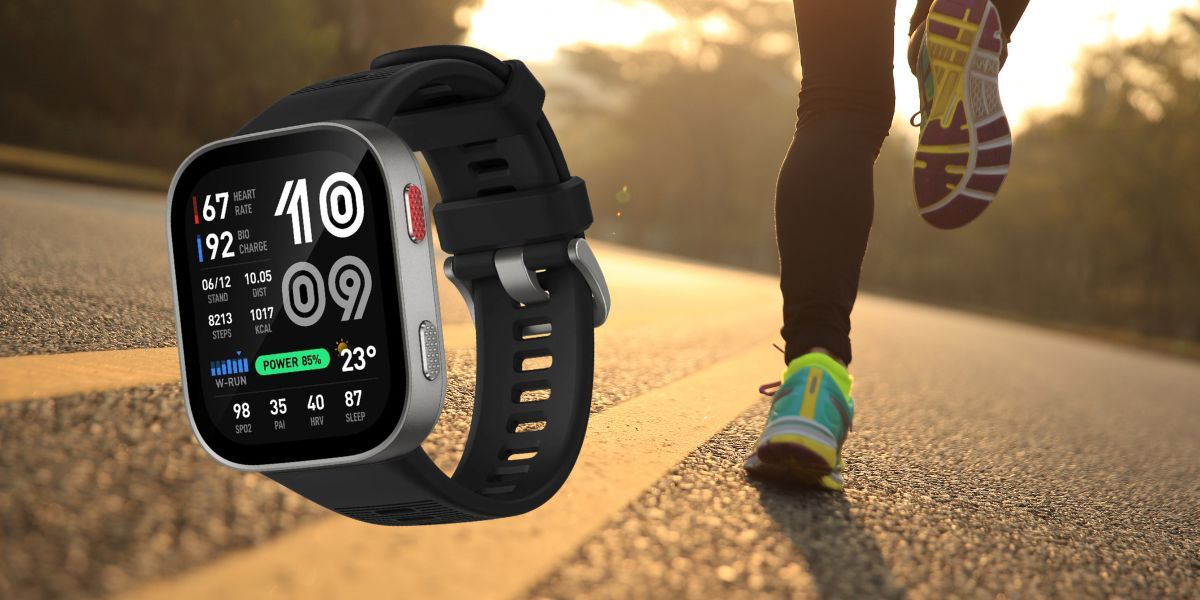
Let us start with the visual experience. The Amazfit Bip Max features a 2.07-inch AMOLED display, and it is a beauty. The screen is a decent size, striking that perfect balance where it does not feel so big that it takes over your entire wrist, but it remains large enough (and vibrantly clear enough) that you can easily read your morning emails without squinting or straining. Even in direct sunlight, the 3,000 nits of peak brightness mean your data is always legible. Wrapped in a lightweight aluminum alloy frame, it looks sleek, modern, and easily transitions from a sweaty gym session to a business lunch.
Bip Max best feature for me though is the battery life. Amazfit claims up to 20 days of endurance, and they are not exaggerating. In everyday practice, I found myself using only about five per cent of the battery each day. You can take this watch on a two-week holiday and confidently leave the charging cable at home. It changes the way you live because it eliminates battery anxiety entirely. You never have to play the game of calculating whether you have enough juice to track your afternoon run. It is always ready.
Underneath that vibrant screen is a surprisingly robust suite of features. The watch introduces Amazfit’s BioCharge energy monitoring system, which tracks your heart rate, sleep quality, and stress levels to give you a daily readiness score. It tells you if you should push hard at the gym or take a rest day. There’s over 150 sports modes and advanced Hybrid Training tools to balance endurance and strength.
Another massive selling point is the 4GB of onboard storage. This might not sound like much in the era of terabyte hard drives, but on a smartwatch, it is incredibly freeing. You can download offline maps directly to the watch and store up to 100 hours of your favourite podcasts or music. Pair your wireless headphones directly to the watch, leave your phone on the kitchen counter, and go for a run. The built-in GPS, backed by five satellite positioning systems, ensures your route is tracked perfectly.
As for the software, the device runs on the Zepp App ecosystem. For those already familiar with the brand, it is worth noting that the Zepp OS 6 update has slightly changed the navigation. The widgets you used to access by swiping left have now been moved to an upward-swipe screen. It takes a day to get used to, but it ultimately feels more intuitive and fluid.
The Comparison: Stacking Up Against the Giants
When you look at the smartwatch market, the Amazfit Bip Max sits in a highly competitive space, often rubbing shoulders with the Apple Watch SE or the higher-end Fitbit models.
Compared to an entry-level Apple Watch, the Bip Max destroys it in battery life. Where the Apple device demands a daily charge, the Bip Max simply keeps going for weeks. The Apple Watch certainly has a smooth integration if you are deeply embedded in the Apple ecosystem, offering more interactive apps and seamless messaging. However, for basic notification reading and health tracking, the Bip Max does the exact same job for a fraction of the cost.
When compared to a Fitbit, the Bip Max shines through its display and lack of paywalls. Fitbit has historically locked some of its best data insights behind a premium monthly subscription. Amazfit gives you all your data, including the BioCharge metric and Zepp Coach personalised training plans, completely subscription-free. You buy the watch, and you own the experience.
Did I enjoy my time with the Bip Max? Immensely. There is a profound sense of relief in wearing a piece of technology that just works without demanding constant attention. It tracked my sleep without dying in the middle of the night, guided my runs with precise GPS, and let me read incoming messages effortlessly.
Final Verdict
The Amazfit Bip Max is an impressive piece of practical engineering. It proves that you do not need to spend upwards of five hundred dollars to get a premium, reliable, and attractive smartwatch. By focusing on what actually matters to users, a bright screen, robust health tracking, offline media storage, and a battery that refuses to quit, Amazfit has created a product that easily integrates into your daily life rather than complicating it.
It’s strange to think that when you look at a price point like this you would generally dismiss it as a “cheap knockoff” but the reality of the user experience is quite different and makes me think that maybe we are just paying way too much for those name brands that spend more time on a charger than on our wrists.
Recommended: Yes, For the price, it is one of the smartest wearable purchases you can make today.