
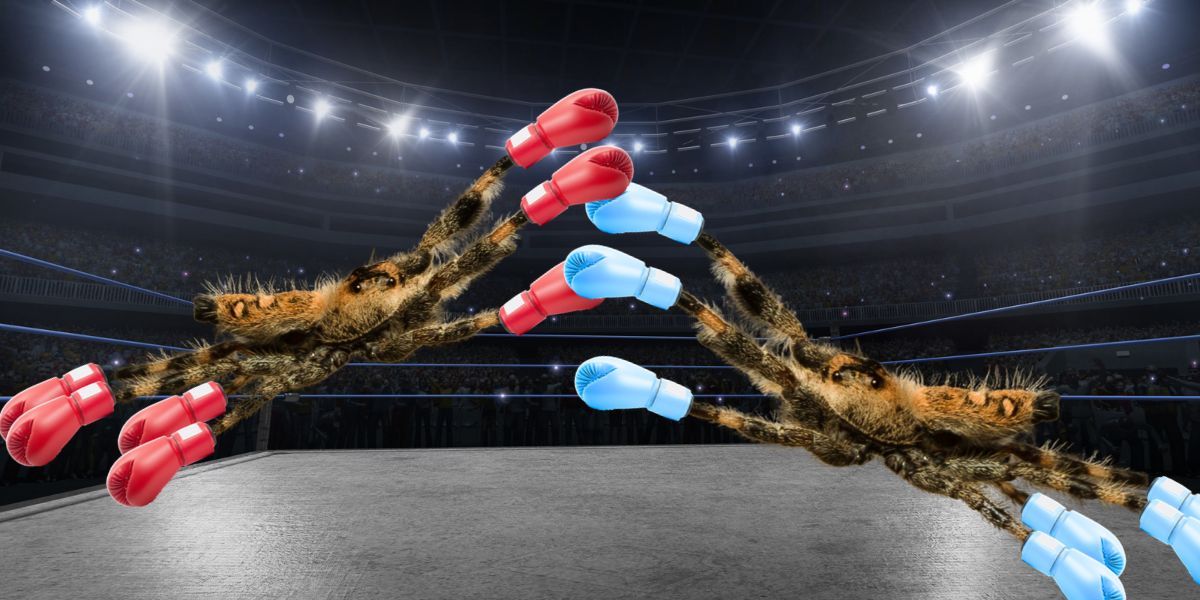
Have you heard of ‘Sabong sa Kaka ’, the Filipino Childhood Tradition of Spider Wrestling on a Stick
In the rural barangays of the Visayas and Mindanao you still have groups of boys (and occasionally some adults) gather around a thin stick (usually the midrib of a dried coconut leaf from a walis tingting broom or a piece of bamboo) with two female orb weavers are at opposite ends. Then with a slight nudge and they move towards each other in a tense, silk throwing battle which ends when one has ensnared the other, the other has fallen off or the other is otherwise incapacitated.
This viral video shows a good crowd watching the event live:
Spider wrestling (or ‘spider derby’) has been a kids’ thing for years in the Philippines, particularly in the Bisaya areas. It’s a game that flourishes where there’s plenty of free time, plenty of trees and plenty of spiders. It’s a form of play and it’s a very early introduction to the concept of competition.
The arena is very simple really. A ref or handler has a stick with a spider on each end and just moves their hand to keep the spiders in. The spiders move in and the fighting starts with legs, bites and silk.
Rules are normally pre-agreed. A bout can be non-lethal (one spider falls a pre-determined number of times, typically three) or more decisive (one is bitten, paralysed and then wrapped). The length of a match can vary from under a minute with very aggressive spiders to several minutes with more reserved ones. In the more friendly games, the handlers will often step in to stop the winner finishing off the loser. Between fights the spiders live in matchboxes with cardboard dividers or in small bottles and jars (portable ‘stables’) which the kids carry in their pockets.
Not every spider is a fighter. Only certain spiders count. Almost all are adult female orb weavers of the genus Neoscona. The ones most commonly used are Neoscona punctigera and Neoscona vigilans (the brown-legged or tiger-tiger spider in Mindanao). Other species in that genus are also used. Males and all other spider families are pretty much ignored. Only these territorial, silk-spinning females are the proper “derby spiders” or damang/kaka.
Catching generally takes place at dawn or dusk when the spiders are out on their webs in the bushes, trees and fields. The more experienced the youngster the better their ability to assess size, aggression and condition. Some will “train” their spiders by feeding them in a particular way, having them spar with dead spiders or some other local method to keep them in good form. The kids can actually sell off a good fighter to another for a small amount of cash.
For many who came up in the provinces it’s just pure nostalgia (the provincial equivalent of a school game before phones and video games). The dads will pass on the spotting skills. There are small crowds at the local matches. You just need a stick and two spiders and it’s the same sort of thing as any other animal contest in terms of the excitement of the prediction and the bragging rights.
Anthropologists and writers have observed its role in enculturation (many boys learn the language and the logic of the game well before they ever get into a cockpit). In some areas it’s a real social centre, particularly at the time of year when the rains are ending and the dry season is beginning and the spiders are out in force.
Similar things happen in other parts of the world. Japan has its Kumo Gassen festival which uses Argiope females. In Malaysia and Singapore the preference is for male jumping spiders. The Philippine version is quite unique in that it is so widespread as a form of everyday childhood pastime in the rural areas.
The activity itself isn’t illegal. Police and local reports have always treated simply catching spiders and getting them to fight as a legitimate pastime. The bit that becomes the problem is the betting.
Any game involving money or articles of value as stakes is illegal gambling. Police have been known to make arrests when they find cash, makeshift arenas and spider boxes in the same place. The penalties are 2 years and 4 months to 4 years and 2 months imprisonment and fines.
Authorities have on occasion also invoked the “Wildlife Resources Conservation and Protection Act” for the collection and killing of wild spiders and in some areas organised derbies are viewed as an affront to public morals. In reality the enforcement is geared towards the betting rather than the various stick fights that take place in the various neighbourhoods amongst the children. Some even inject substances to improve the spiders strength. This is where the problems start.
The videos of the matches keep reappearing and generate all sorts of reactions: nostalgia from those who were brought up on it, plenty of jokes (comparing it to Pokemon), and some division as animal welfare concerns that do draw a parallel to cockfighting are brought up.
A study in Mindanao actually found that the majority of the spiders taken are mature females which does raise issues in terms of the local population, though it’s still a very decentralised and small-scale activity in comparison to commercial animal sports.
What keeps it going is its accessibility and its familiarity to the culture. In areas where there’s very little modern entertainment to be found, two spiders on a stick still provide a good deal of drama, a sense of community. It may be viewed as just harmless play, it may be the first real exposure to gambling that a child ever has, it may be something that should be dying out as people become more aware of the wildlife.
How do you look at it?